
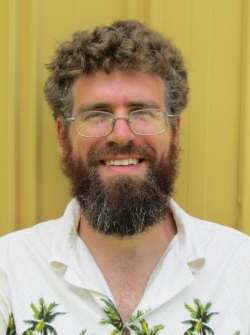
 Congratulations to Brandon Zimmerman, who defended his doctoral dissertation, with distinction, on December 4th! His topic was "Avicenna’s Metaphysics: Does Plotinus Present an Account of Creation?" and his director was Mathias Vorwerk, Ph.D., Provost and Professor of Philosophy at the University of Dallas. Mr. Zimmerman is an Assistant Professor in Philosophy and Core Teaching Fellow at the University of St. Thomas (Houston).
Brandon Zimmerman was born in Baltimore and grew up in York County, PA. He graduated from the Templeton Honors College at Eastern University in 2005 with majors in Philosophy and History and a minor in Political Science. After a year working with the poor in Baltimore through the Capuchin Volunteer Corps, Brandon began graduate studies at the Catholic University of America, graduating with an M.A. in philosophy in 2009. Under the sponsorship of the Capuchins (St. Augustine province) Brandon and his wife worked in Catholic Seminaries in Papua New Guinea from 2013 to 2024. Brandon was the Dean of Studies for Catholic Theological Institute (Port Moresby) from 2018–2023 and also did work in inter-religious dialogue for the Catholic Bishops Conference of Papua New Guinea. Relocating to Houston in 2023 with his wife and six children, Brandon is now an Assistant Professor in Philosophy and Core Teaching Fellow at the University of St. Thomas (Houston).
Dissertation Abstract:
One of the central theses of Neothomism is that the doctrine of creation is not knowable through natural reason, but once the doctrine is revealed, it and the metaphysics of existence it entails solve the metaphysical questions about being and its causes which Plato and Aristotle failed to satisfactorily answer. Accordingly, Plotinus, as a pagan, did not grasp creation, but conceived of God as somehow part of or in need of the world.
In fact, this understanding of creation is at variance with Aquinas’s actual teachings. For Aquinas, creation is a metaphysical doctrine discovered by all who engaged in the study of being qua being, including Aristotle and the Platonists. The fact of creation is shown by demonstrating that there is one universal cause of being. The essential meaning of creation is that the first cause produces all things out of nothing preexisting and that all things whatsoever continuously depend on it for their existence. Philosophers can be wrong about the details, such as whether God creates through intermediaries or by necessity, but still have grasped the fact and essence of creation.
The philosophical search for a creator began with the project proposed by Plato in Republic VI–VII of establishing an absolute First Principle and then explaining everything through it. The majority of Plato’s students attributed two opposed first principles, the One and Dyad, to Plato, a doctrine that Aristotle attacked as incoherent. Hermodorus, however, claimed that matter only has relative existence, and so there is only one first principle. The Pythagorean branch of Platonism preserved this teaching and clearly expressed it well before Christian Apologists made unequivocal statements of creatio ex nihilo.
Plotinus’s great achievement was to carry out Plato’s project of demonstrating that there is and can be only one first principle and to articulate the One’s causality in a manner that lines up with Aquinas’s account of the essence of creation. Plotinus was mistaken about many of the details of creation, but he set the essential doctrine of creation as the definitive interpretation of Plato and Aristotle’s account of first principles, an interpretation Aquinas continued.