
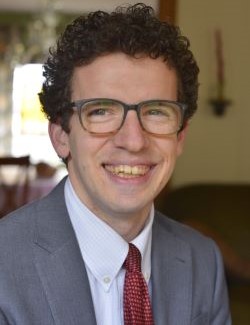
 Congratulations to Brian Killackey , who defended his doctoral dissertation with distinction on April 24th! His topic was "Knowing and Thinking We Know: Awareness of Ἐπιστήμη in Aristotle" and his director was Jonathan Buttaci, Ph.D., Assistant Professor of Philosophy at the Catholic University of America.
Brian Killackey was born and raised in New Jersey. He received his bachelor’s degree in classics and philosophy from Christendom College in 2012. After two years volunteering abroad and three years working in the software field, Brian followed the siren song of philosophy, receiving his M.A. from The Catholic University of America in 2020. Brian lives in Gastonia, North Carolina with his wife Ellie and his son Joseph. He teaches philosophy at Belmont Abbey College.
Dissertation Abstract:
Aristotle’s treatment of scientific knowledge (epistēmē) has long inspired scholarly attention. This attention has primarily been directed at the question, “When do we possess scientific knowledge?” I argue that Aristotle’s answer to this first question also highlights a related question: “When do we think we possess scientific knowledge?”
Based on an analysis of parallel passages that use similar language, I show that Aristotle’s preliminary definition of scientific knowledge in Posterior Analytics A.2 does not use “thinking” language merely to report a reputable opinion. I also show that Aristotle’s usage of “thinking” language in the case of scientific knowledge and opinion (doxa) reveals contrasting cognitive entailments: If I have scientific knowledge, then I think that I have it, though the converse is false. On the other hand, if I think I have doxa, then I have it, though the converse is false. I argue that self-ascription’s role in constituting various cognitive objects explains these differing entailments.
In my final two chapters, I consider the theme of self-ascription of scientific knowledge under two headings. First, Aristotle is concerned, most obviously, with those who mistakenly claim to have scientific knowledge. Though scientific knowledge is always correct, we are often mistaken in our individual self-ascriptions of this state. I show how the application of inappropriate principles and methods of scientific inquiry can lead to such mistaken self-ascriptions. Second, I examine Aristotle’s positive claim that those who have scientific knowledge also think that they have it. I show how Aristotle’s more general theory of cognitive awareness allows him to make this claim without committing himself to an infinite regress of higher-order cognitive attitudes. I also show that the awareness of scientific knowledge is not merely an instance of Aristotle’s broader commitments about cognitive awareness, since this awareness involves self-ascription of scientific knowledge under the correct description and applies not only to occurrent cognitive acts but also to habitual cognitive states.